
Celebrating Ten Years
A Big Birthday for a New Astronomy

I had the pleasure of being on a run in the hills just north of Glasgow last week on a clear night with some other folk in my running club. Because people know that I’m an astronomer, they tend to point up and ask me “what’s that thing?”, and I find myself becoming an impromptu tour guide for the sights of the night sky. While it’s become a bit of a party trick, it’s nice to remember that even half way through a run in the dark and middle of winter, everybody can find themselves full of curiosity at the Universe. Welcome to the first issue of my newsletter, where I hope you’ll be able to learn more things about what I do to try and understand Universe (and probably some things about hills and running too; feel free to skip the bits you don’t want!).
Ten Years of Gravitational Waves
For the first time in September 2015 the LIGO detectors in the USA picked up the faint signal created by two black holes colliding with each other, sending ripples which travelled through spacetime until they reached the Earth. I was lucky enough to have courtside seats for everything, though I didn’t realise at first. We detected GW150914, the gravitational-wave so-named because it arrived on 14 September 2015, on the day that I joined the LIGO collaboration. Back in September I put together some thoughts about what it was like to accidentally witness the start of a scientific revolution on my blog here: https://daniel-williams.co.uk/2025/09/14/ten-years-of-gws.html.
It took a while before we made the big announcement, and we’re rapidly approaching the tenth anniversary of that, which happened on 11 February 2016. You can find my thoughts from ten years ago here (and most of this page still works despite multiple changes to my blog in the intervening decade!): https://daniel-williams.co.uk/2016/02/11/grav-wave-discovery.html.
Of course, there were a lot of other people around who had a better understanding of what was going on. We took the opportunity of the whole world of gravitational science converging on Glasgow last summer for a conference to collect some reminiscences:
.
STFC Proposed Cuts
Unfortunately, while we’re celebrating a major success for curiosity-driven science, there has been very disturbing news about future funding of this sort of research in the UK over the last couple of weeks.
Astronomy research in the UK is mostly funded by UK Research and Innovation (UKRI), the umbrella body which includes the Science & Technology Facilities Council (STFC), through which astronomy is funded. STFC have advised that in the near future budgets are likely to be cut by around 30%, but research groups are being asked to consider the effects of cuts up to 60%.
It’s hard to overstate how devastating this would be to UK science (STFC funds astronomy, particle physics, and astroparticle physics [which gravitational waves fall under]). The majority of researchers rely on funding council support at some point in their career directly, often when at an early-career stage. I am one of those researchers, so it’s rather terrifying to see these numbers thrown around.
The proposed new investment strategy has some good news for some areas of science, and those are to be welcomed, but unfortunately it seems to be coming at the expense of investment in fundamental science. Curiosity-driven science is fantastic value for the country; the UK has leadership roles in major international collaborations thanks to STFC support (again, I am very lucky to be in just this sort of position; it’s hard to imagine that would be possible in the proposed model). The UK sits as a scientific power-house alongside much larger countries like the USA and Germany in producing research into how the Universe works. It is something the country can be genuinely proud of, but taking a bulldozer to this success story is a mistake.
Standing outside, looking up on a clear, dark night, most of us find ourselves wanting answers to the Universe’s deepest questions. To answer these questions we need to fund research.
You can find more details about the impact on early-career researchers in this open letter: https://ecr-openletter-stfc.github.io/
The Royal Astronomical Society have also responded: https://ras.ac.uk/news-and-press/news/proposed-budget-cuts-catastrophe-uk-astronomy.
As have the Institute for Physics: https://www.iop.org/about/news/vital-science-cut-in-devastating-blow.
It’s also been covered in the Financial Times: https://giftarticle.ft.com/giftarticle/actions/redeem/9d37d6cc-ef80-401c-b989-72cb1810b262.
It’s unlikely this will be resolved quickly, so I imagine I’ll have more thoughts about what to do in the near future!
Recent things
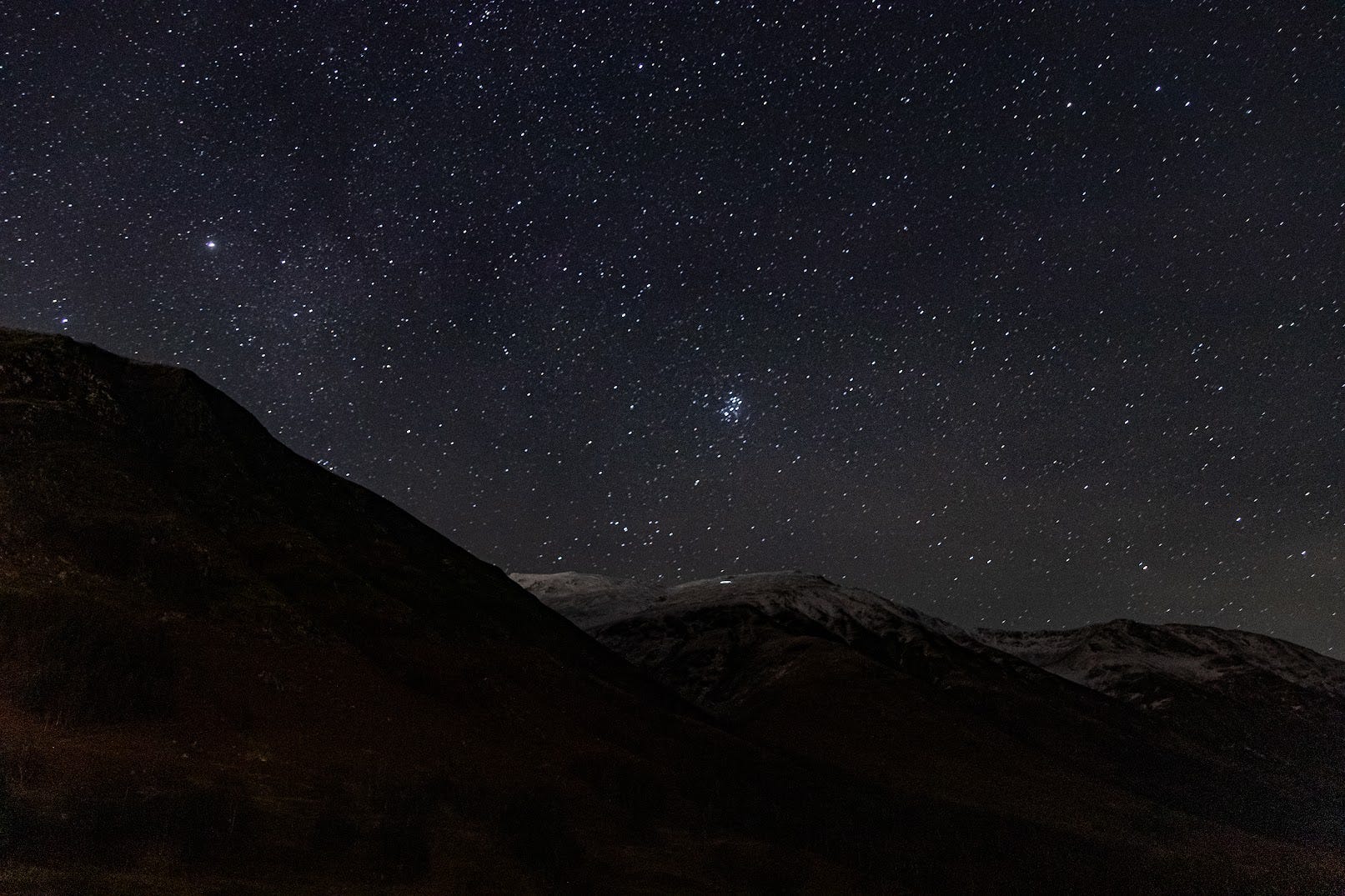
I had the opportunity to give some talks outside Glasgow earlier in the winter when I travelled north to Wester Ross Dark Skies Festival where I spoke in Applecross and Torridon about black holes and gravitational waves. Unfortunately while the skies were dark I was there in the middle of a blizzard, so there wasn’t much stargazing to be done while I was there (though I managed to take the photo in this section on my way back to Glasgow looking up to Ben Nevis from just outside Fort William. If you’re in Wester Ross next November I recommend checking-out this great little festival! https://wrb.scot/sustainable-development/wester-ross-dark-skies-festival
Events on the Horizon
12 February Next week Prof Giles Hammond, the deputy director of the Institute for Gravitational Research (where I work!) at the University of Glasgow will be giving a lecture celebrating the detection anniversary and the first decade of GW astronomy. 6pm (doors 5:45pm) Thursday 12 February, Lecture Theatre 257, Kelvin Building, University of Glasgow.
20 February I’m giving a talk to Airdrie Astronomical Association later this month, details here:
https://www.airdrieobservatory.com/
Thanks for hanging about until the end! I’m sure future issues will vary a bit in focus, but I’ll try my best to keep them interesting! You can subscribe to this newsletter here on substack, or on LinkedIn: https://www.linkedin.com/build-relation/newsletter-follow?entityUrn=7425589233001857024